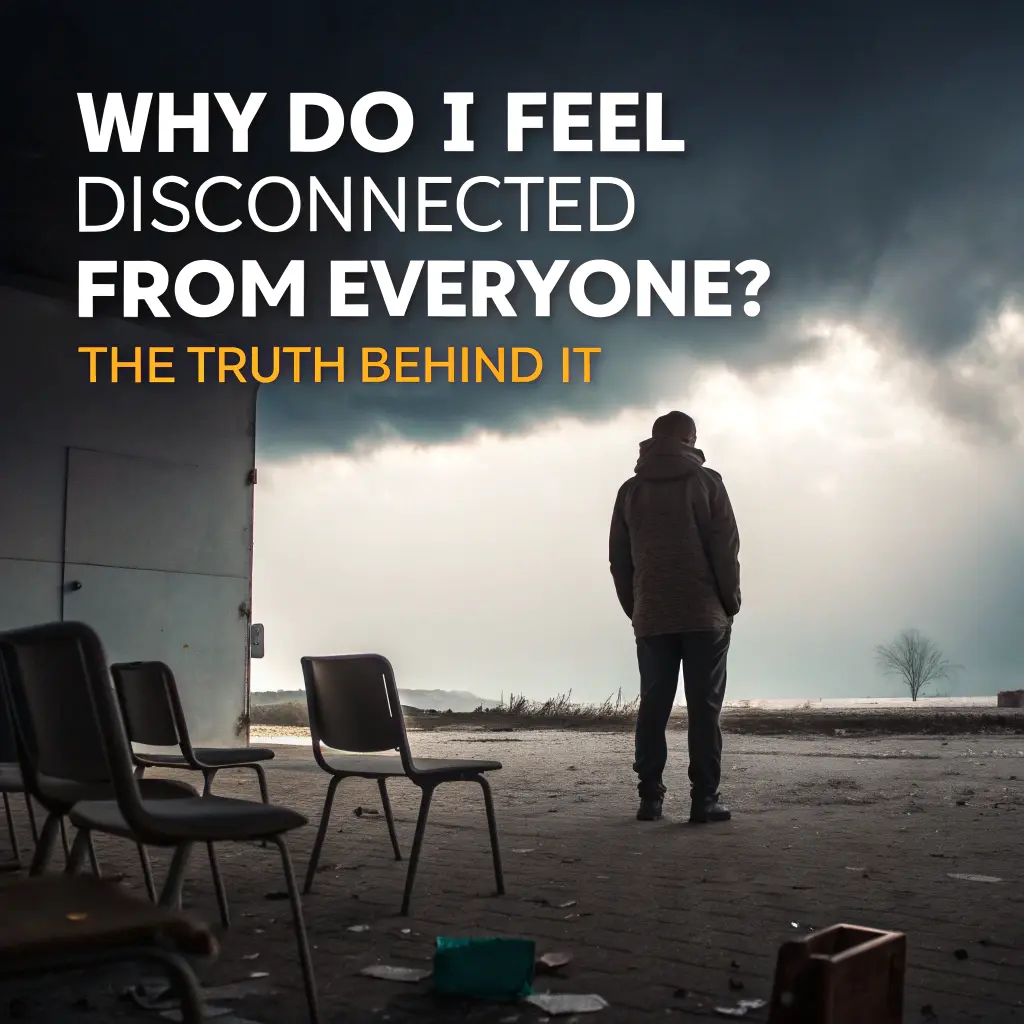
If you feel like this, you are not weird, you are not someone who hates people, and you are definitely not alone. You might just be carrying something inside you that is hard to explain.
The Psychology of Pulling Away: Why Do I Feel Disconnected From Everyone
From a psychological point of view, wanting to be alone is often your body trying to protect you. If you have had difficult experiences with people in the past, your brain may start to see people as unsafe, and this happens without you even realizing it.
Your body can feel constantly tired, and you may feel numb or disconnected. Talking to people may start to feel pointless, not because you do not care, but because your system is trying to conserve energy.
This can also come from early experiences. If you were hurt when you opened up to someone, your body learns to stay closed. Over time, distance starts to feel safer than connection.
So what you are feeling is not random—it is a response your system learned to protect you.
The Energy Part: When You Feel Drained Around People
There is another layer to this, which is energy. We are always affected by the people and environments around us. You may have noticed that some places make you feel heavy, while others make you feel light and comfortable.
Some people are more sensitive and can pick up on emotions, tension, and unspoken things around them. This can become overwhelming, especially when you are constantly around people without space to reset.
Because of this, choosing to be alone becomes a way to protect your energy. It is not avoidance—it is regulation.
Sometimes, being alone is not a problem at all. It is a phase where you are processing things, understanding yourself, and going through internal change.
The Spiritual Part: Wanting Real Connection
One important thing to understand is this – people who feel disconnected do not always want to be alone. They actually want connection, but not just any connection.
They want something real. Honest conversations, presence, and depth. When all they experience is surface-level interaction, it can feel exhausting and meaningless.
Sometimes, feeling disconnected from others is actually a sign that you are disconnected from yourself. If you do not fully understand your own emotions or needs, being around people can feel confusing or draining.
The way back to connection often starts with yourself – understanding how you feel, what you want, and what you truly need.
What Family Constellation Therapy Says: Why Do I Feel Disconnected From Everyone
Family Constellation Therapy suggests that what you are feeling may not have started with you. We are all part of a family system, and patterns from the past can continue without being spoken about.
If something painful happened in your family, it can still affect you today – even if you do not consciously know about it.
Sometimes, the feeling of disconnection is not yours alone. It may belong to someone in your family who felt excluded, alone, or disconnected.
These patterns get passed down silently, and you may end up carrying something that was never resolved.
Family Constellation Therapy helps bring these patterns into awareness. And when you see what is happening clearly, something inside you begins to shift.
Three Important Things to Understand
Everyone in a family has the right to belong. When someone is excluded, that feeling does not disappear – it can show up in future generations as isolation or disconnection.
There is also an order in families. When this order is disturbed, it creates emotional imbalance and confusion in relationships.
At the same time, relationships need balance – giving and receiving. When this balance is missing, it becomes difficult to connect or feel supported by others.
These patterns are not always visible, but they strongly influence how you experience connection.
What to Do When You Feel Disconnected
If you have been pulling away from people, do not force yourself to suddenly become social. Instead, slow down and try to understand what is happening inside you.
Give yourself space to observe your thoughts, feelings, and reactions without judging them.
Ask yourself when you first started feeling this way, and whether this feeling truly belongs to you or comes from somewhere deeper.
Also notice what your body is trying to protect you from. There is always a reason behind the way you feel.
Sometimes, the best way to reconnect with others is to first reconnect with yourself.
You do not need to prove anything by being social. You already belong, just as you are.
Conclusion
Feeling disconnected from people is not a flaw – it is a signal. A signal that something inside you needs attention, understanding, and healing.
When you start looking deeper instead of judging yourself, things begin to make more sense.
With awareness, this feeling can slowly change. Connection does not come from forcing yourself – it comes from understanding yourself.
You are not meant to stay disconnected. You are meant to find your way back – to yourself, and then to others.
Read more articles
Are You Carrying Pain That Isn’t Yours? Understanding Ancestral Family Trauma
Family Constellation for Family History: Understanding Hidden Ancestral Patterns
Parenting: A Guilt Trip
Save my name, email, and website in this browser for the next time I comment.
- What Is the Sandwich Generation? Raising Kids While Caring for Ageing Parents
- Thyroid and Stress: Is There a Real Mind-Body Connection?
- Can Chronic Illness Be Linked to Family Patterns? A Family Constellation Approach
- Why Do I Feel Responsible for Everyone? Family Constellation Hidden Family Roles
- How Family Constellation Therapy Helps Break Toxic Cycles
- Arjun Gupta on How I overcame my Degenerative Disc Autoimmune Disease?
- Srinivas Rao on Emotional Resilience
- Venkatesh Iyer on Emotional Resilience
- Ramesh Naidu on Emotional Resilience
- Sai Kumar on How I overcame my Degenerative Disc Autoimmune Disease?
Where to start
If any of this describes something you recognise, the first step is a conversation rather than a commitment. A free consultation exists to work out what would genuinely help — including saying plainly if this is not the right approach for you.